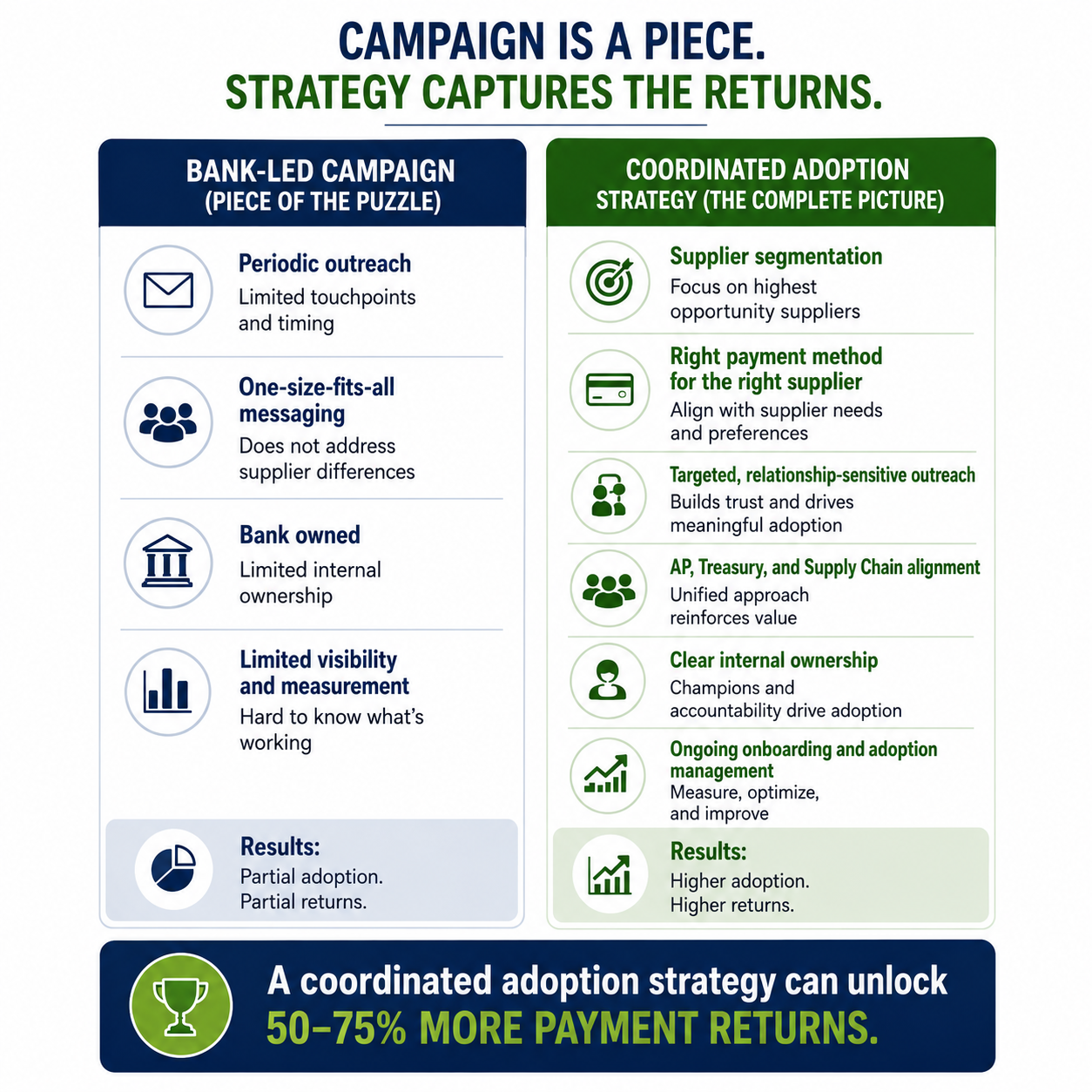
A coordinated Supplier Adoption Strategy can unlock 50-75% more Payment Returns
If a bank-led supplier campaign is your only digital payment adoption strategy, you’re likely leaving 50–75% of available payment returns on the table.
Bank-led campaigns can help raise awareness and does drive some digital payment adoption. They are a valuable piece of the puzzle.
But for many Healthcare organizations, they become the primary — and sometimes only — supplier adoption strategy.
That is where the opportunity gets limited. A coordinated supplier adoption strategy does not replace the bank-led campaign. It helps maximize it. Because the campaign becomes much more effective when it is supported by:
• Supplier segmentation — focusing on the suppliers that create the greatest payment opportunity
• Right payment method for the right supplier — matching solutions to supplier preferences, working capital goals, and relationship dynamics
• Targeted, relationship-sensitive outreach — because one-size-fits-all messaging rarely drives meaningful adoption
• AP, Treasury, and Supply Chain alignment — creating a unified approach that balances returns, supplier experience, cost, and risk
• Clear internal ownership — because adoption needs champions and accountability, not just a campaign
• Ongoing onboarding and adoption management — because adoption is not a one-time event; it requires follow-through, measurement, and continuous improvement
When these elements are in place, bank-led campaigns become more targeted, more credible, and more effective.
And organizations can capture significantly more payment returns through higher adoption, improved working capital, stronger supplier relationships, and lower cost.
The takeaway:
- A bank-led campaign is a helpful start and key part to adoption.
- But a coordinated adoption strategy is what helps maximize the campaign — and capture the full financial impact.
- Don’t leave 50–75% of your available payment returns on the table.
Learn More about P2P Transformation
If you would like to learn more about the Financial Impact true P2P Transformation could have on your organization schedule a consultation with us.
Book a Consultation