A Virtual Card Program does not equal Payment Optimization Strategy
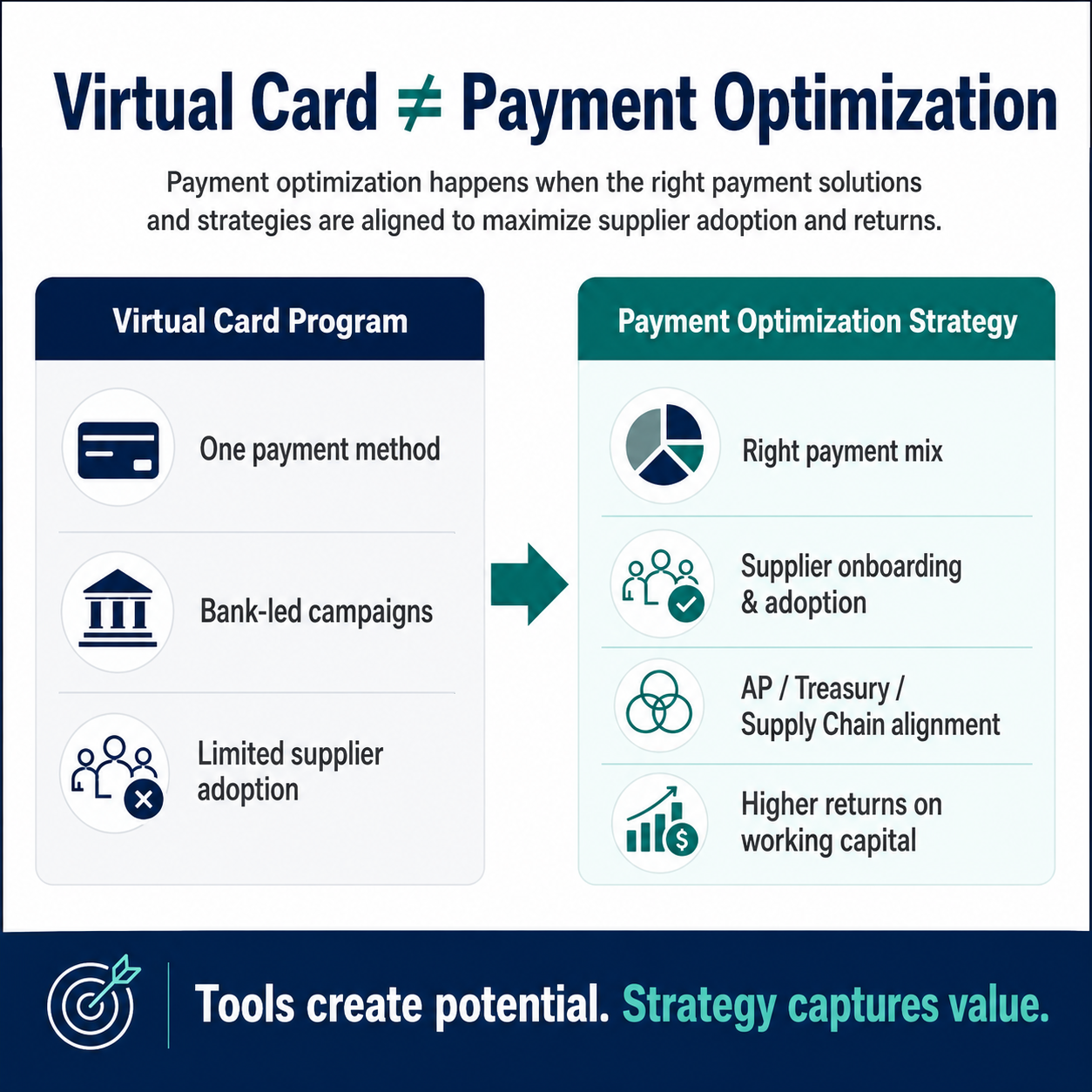
Having a Virtual Card program does not mean you have a Payment Optimization Strategy... Payment Optimization happens when the right payment solutions and strategies are aligned to maximize supplier adoption and returns.
Many Healthcare organizations have a virtual card program in place and assume they are optimized.
But virtual card is only one payment method.
It has real value, but it does not, by itself, maximize the full payment opportunity.
True payment optimization requires a coordinated strategy that considers:
• The right mix of payment solutions
• Supplier segmentation
• Supplier onboarding and enablement
• AP, Treasury, and Supply Chain alignment
• Payment security and fraud reduction
• Cost efficiency
• Supplier experience
• Returns on working capital
This is where many organizations leave value on the table.
• They rely heavily on annual bank-led campaigns.
• They lack a structured internal supplier adoption strategy.
• They do not always have the full set of payment options needed to meet different supplier needs.
• And AP, Treasury, and Supply Chain are often not fully aligned around the same financial and supplier relationship objectives.
The result?
Supplier adoption stalls.
Returns on working capital remain under-captured.
And the organization assumes the program is “optimized” when it may only be capturing a fraction of the opportunity.
The takeaway:
- Virtual card is a valuable tool.
- But payment optimization is a strategy.
- The greatest financial impact happens when the right solutions, suppliers, owners, and adoption model are aligned to capture the full opportunity.
Learn More about P2P Transformation
If you would like to learn more about the Financial Impact true P2P Transformation could have on your organization schedule a consultation with us.
Book a Consultation